TaipeiEcon
Inventory of all articles of TaipeiEcon
Inventory of all articles of TaipeiEcon
Taipei City has been actively integrating AI technologies into healthcare and care settings in response to an aging population and the digital transformation of medical services in recent years. Across pre-hospital emergency and critical care, rural health screenings, chronic disease care, and home health management, AI applications are increasingly being integrated into healthcare service delivery, helping improve diagnostic accuracy, risk assessment, and care coordination. Leveraging its medical resources, R&D capabilities, and the smart city innovation validation mechanism, Taipei City continues to expand smart healthcare applications to meet the healthcare needs of its residents.
According to the Global Market Insights 2024 report, the global AI healthcare market reached US$32.34 billion in 2024 and recorded a compound annual growth rate (CAGR) of 38.23%. This indicates that AI has become a key development trend in the global healthcare industry.
In 2025, older adults aged 65 and above accounted for 24% of Taipei City's population, marking Taipei City's transition into a super-aged society. In response to the healthcare needs of a super-aged society, the Taipei City Government is actively applying AI technologies across healthcare, long-term care, and health management to improve the efficiency and quality of healthcare services.
Taipei City also boasts comprehensive medical and R&D capabilities. These include 10 medical centers, 44 accredited hospitals, as well as national institutions such as Academia Sinica and the National Health Research Institutes (NHRI). According to the Taiwan Food and Drug Administration (TFDA), more than 60% of medical device vendors receiving AI/ML technology-related approvals between 2020 and 2025 were located in Taipei City, the highest proportion in Taiwan. This has also enabled AI technologies to be applied in real-world settings such as clinical diagnostics, healthcare, and elder care.
The "Integrated Emergency and Critical Care System" of the Taipei City Fire Department went live at the start of 2025. Ambulances transporting patients can use the app to connect to Bluetooth physiological monitors and then transmit the patient's vital signs and ECG data to the hospital in real time. AI-assisted interpretation technology can also be employed to provide the medical team with advance information on the patient's condition. The integration of a TFDA-approved AI ECG interpretation system in July of the same year means the system can now assist paramedics with identifying myocardial infarction on the way to the hospital. The results are transmitted to the hospital in real time, allowing the cardiac catheterization team to be activated an average of 6 minutes earlier, improving emergency and critical care response times. The system also won the "Innovation Application Award - Smart Healthcare Award" in March 2026, demonstrating Taipei City's successful integration of AI and digital technologies into the emergency medical services system.
Taipei City Hospital has also extended AI technology to health screenings in remote rural areas. A team from Taipei City Hospital traveled to Beigan Township in Lienchiang County to conduct health screenings using AIoT ECG equipment. AI-assisted analysis was conducted on heart age and function metrics to assess the risk of acute cardiovascular events. ECG anomalies were detected in 23 residents, including 6 who were identified as being at moderate-to-high risk of cardiovascular disease.
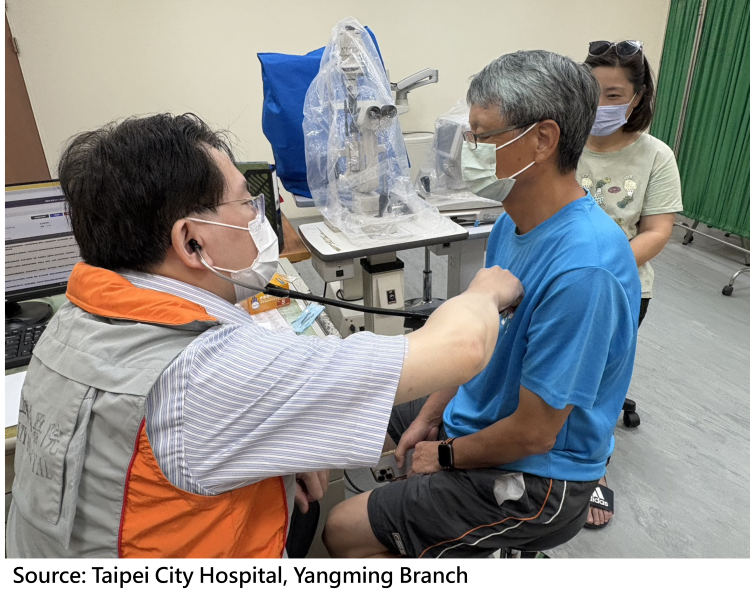
AI technology is not just being applied to emergency and critical care and health screenings. Taipei City continues to integrate AI technologies into chronic disease care and health management. The "AI-Enabled Diabetes and Kidney Care Clinic" developed by Taipei City Hospital uses AI to integrate voice-based consultation, clinical decision support, medication and health management functions. These are linked to the diabetes and chronic kidney disease care pathway to improve care efficiency and information management of the medical team. The program also provides continuous smart care from hospital to home, demonstrating the application of AI technologies in chronic disease management and healthcare.
Taipei City continues to use the smart city innovation validation mechanism to build upon existing healthcare accomplishments and explore potential AI applications in home care and health promotion. For patients with Parkinson's disease, for example, it can be difficult to monitor changes in condition outside of the consultation room. Taipei City Hospital is now using AI-enabled applications to help patients record their hand movements and gait at home. AI video analysis is also used to improve diagnostic accuracy. At the same time, the Department of Health, Taipei City Government has employed AI technology to analyze a variety of data and provide assessments on chronic disease risk. The findings are converted into easy-to-understand health information to help the general public better manage their own health.
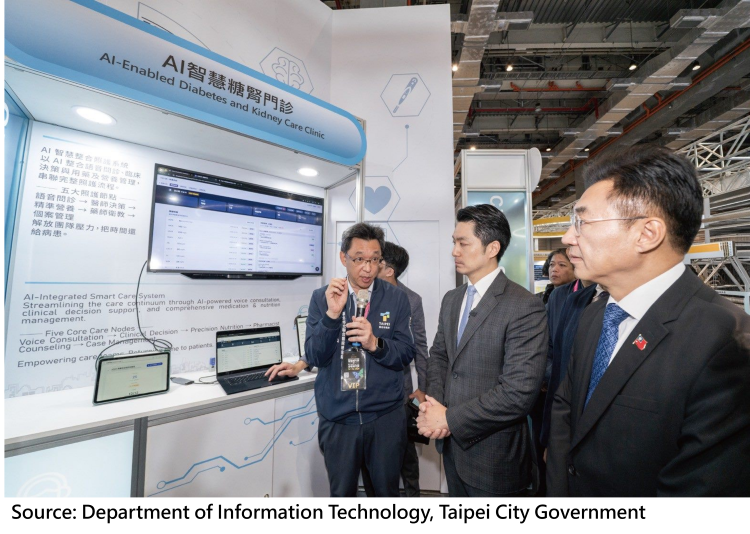
From emergency and critical care and remote rural health screenings to chronic disease care and home health management, AI technology is gradually being incorporated into Taipei City's healthcare service system. AI applications are also extending beyond hospital settings into everyday life. Smart healthcare applications provide city residents with more timely, accurate, and accessible medical and healthcare services. This brings technological innovation closer to the everyday needs of city residents.
In response to the healthcare needs of a super-aged society as well as the digital transformation of medical services, Taipei City is currently leveraging its comprehensive medical system, extensive R&D capabilities, and diverse innovation resources to continue advancing toward becoming a smart healthcare city that integrates innovative R&D, clinical validation, and comprehensive healthcare services.