TaipeiEcon
Inventory of all articles of TaipeiEcon
Inventory of all articles of TaipeiEcon
The Taipei City Government is promoting smart city development by vigorously introducing various AI applications aimed at citizen convenience. Key implementations include AI instant translation for medical/tourism needs, AI/AR integration in zoo smart guides for education, and AI voice-to-text technology in the 1999 hotline for optimized efficiency and accuracy, ultimately enhancing the quality of municipal services in Taipei.
Under the Taipei City Government's "AI-Driven Smart City" framework, AI technologies are being gradually introduced into municipal services. As developments in generative AI accelerate, the Taipei City Government is transforming its objectives. Beyond merely seeking automation and efficiency, the city aims to transition its services from a historically reactive stance to one of proactive and preemptive engagement. The initial applications by the Taipei City Government have served as a proof of concept for the new service model. This successful experience establishes a foundation for future development, showcasing the full potential of AI technology in urban governance.
The global consulting authority Gartner points out that AI is fast transforming into Agentic AI, which can execute tasks independently. This technology is expected to manage 15% of all routine global decisions by 2028. This technological shift elevates AI beyond simple repetitive tasks, enhancing its ability to analyze, reason, and make judgments, and empowering it to execute complex decisions autonomously. Utilizing this technology enables the Taipei City Government to broaden its service reach without increasing staffing, offering municipal services that are more citizen-centric and proactively transforming how city services are delivered.
Given Taipei's nature as a city with high interaction density and international exchanges, strategically implementing AI in high-impact service areas is essential to deliver meaningful, smart services that citizens can truly experience. In light of Taipei City's frequent international communication and requirements for major events, we have prioritized three service areas for AI integration: "cross-language communication," "digital guidance in major venues," and "handling large volumes of citizen feedback". To address the prioritized service needs, the Taipei City Government is gradually deploying AI in public services in accordance with global trends and local demands. Specific applications rolled out include AI translation, smart zoo navigation, and the AI voice-to-text system for the 1999 Citizen Hotline. The Taipei City Government is redesigning municipal services around citizens' needs.
To satisfy the growing need for multilingual support in Taipei's tourism and medical fields, the City Government has pioneered the use of AI translation applications within its public services. Taipei City Hospital has deployed AI instant translation devices at 27 healthcare locations. This includes the establishment of AI translation counters and tablets, supporting instant, multilingual conversations in languages such as English, Japanese, Korean, Vietnamese and etc. The service not only transcends language barriers and enhances the accuracy of patient-physician communication, but through a redesigned workflow, it also ensures that foreign patients receive the same immediate and transparent medical information as local citizens—from check-in to consultation.
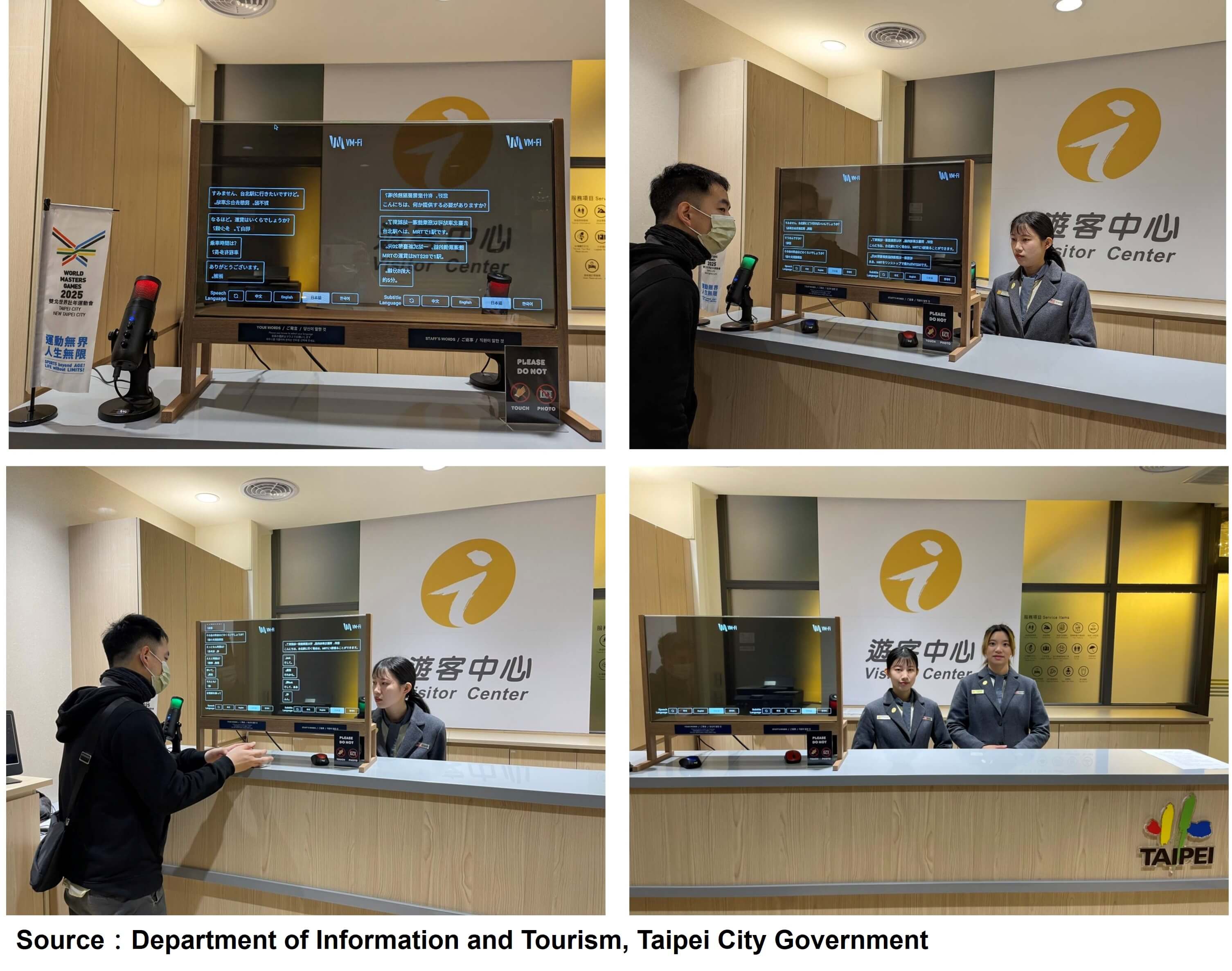
Planned by the Department of Information and Tourism, Taipei City Government, the technology was expanded for tourism use, specifically deployed at the Tourist Service Centers in the major international hubs of Taipei Main Station and Taipei Songshan Airport to offer multilingual services to global visitors. Additionally, the 2024 Taipei Lantern Festival saw the first implementation of a "Smart Translation Transparent Panel" at the Ximending Visitor Information Center, providing real-time multilingual service in English, Japanese, Korean and etc. This initiative shifted the service model from simple information distribution to deep, instantaneous, two-way communication, positioning the city's international portals as vital showcases of both technology and hospitality.
These applications highlight the Taipei City Government's rapid adoption of AI trends while maintaining a citizen and visitor-centric approach. The AI instant translation lowers the communication threshold for new residents and foreign nationals in medical and tourism settings, minimizing misinformation caused by language barriers. These measures further guarantee efficiency in healthcare and quality in tourism, making public services more inclusive and reassuring. This cultivates Taipei's international reputation as a friendly and accessible destination, boosting its appeal to global talent and tourists.
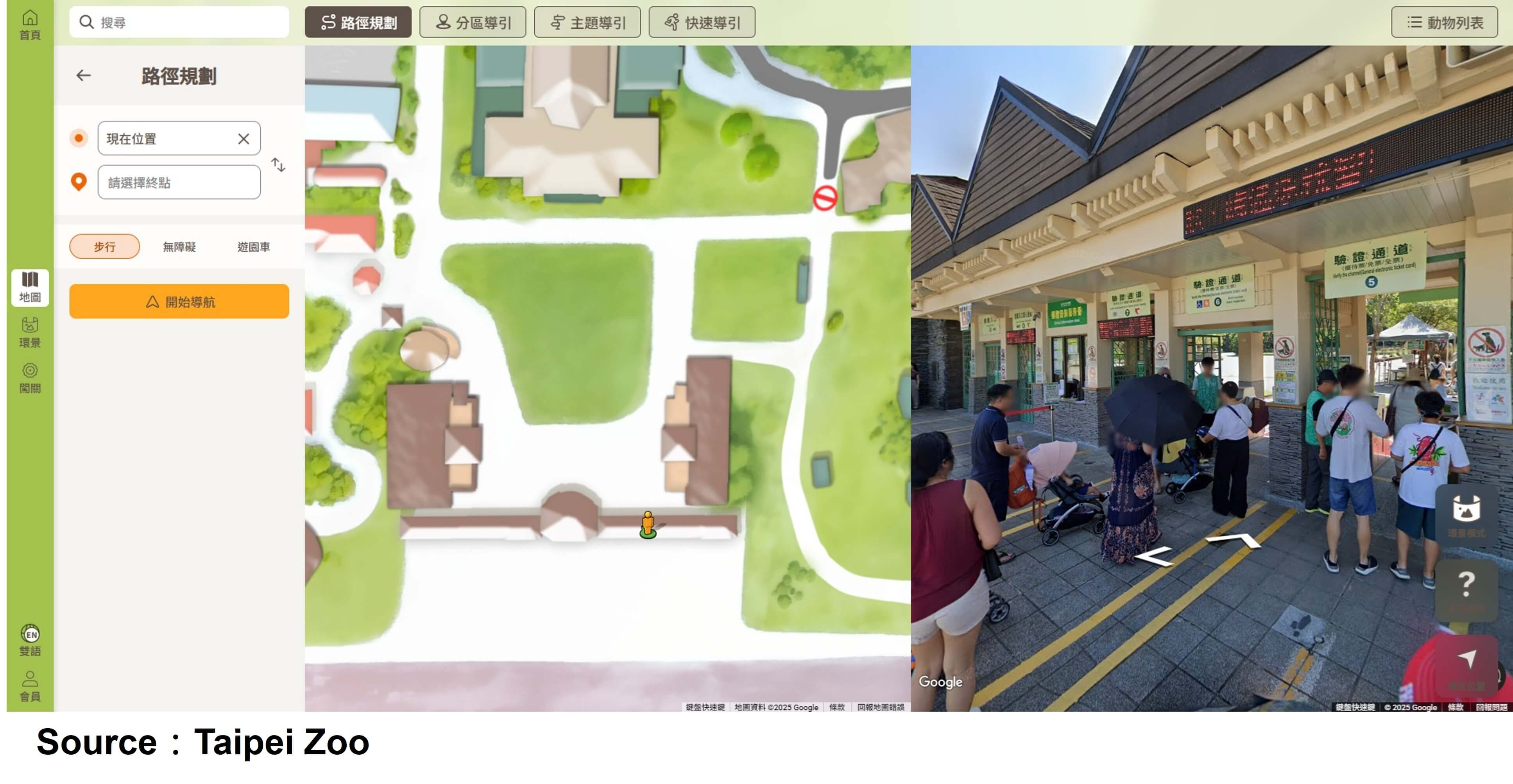
In addition to healthcare and tourism, the rising demand for leisure activities highlights new challenges: visitors to large facilities frequently waste time navigating vast sites with complex routes. Moreover, conventional, one-directional guidance fails to satisfy guests' growing need for personalized and immersive exploration. Consequently, the Taipei City Government introduced Augmented Reality (AR) at the Taipei Zoo, utilizing AI technology to facilitate the transformation of its service model.
The Taipei City Government's new "Intelligent Zoo Guided Navigation" system goes beyond simple digital maps. By leveraging AI analytics, the system delivers customized routing recommendations to visitors. It further integrates AR technology, weaving ecological facts, interactive puzzles, and photography elements into the experience. This approach provides visitors with flexible control over their visit while using interactive design to enrich the educational value of the tour.
The digital map transforms the visitor experience from passive to active, self-guided exploration. This AI-powered innovative guidance enhances engagement, particularly for families and students, and substantially elevates the zoo's educational impact. Through the smart upgrade, the zoo transcends its role as a recreational space, establishing itself as a benchmark smart facility in Taipei, demonstrating the city's technological strength and commitment to ecological education.
In addition to the introduction of new technologies across various sectors, the 1999 Citizen Hotline is the main municipal channel for citizen communication. As a crucial point for gathering initial feedback, the challenge is handling a massive daily call volume efficiently, requiring a balance between swift recording and precise responsiveness. The traditional method of relying on agents for word-for-word transcription poses significant risks to frontline service efficiency. In addition, documentation errors can easily delay the timely resolution of municipal issues.
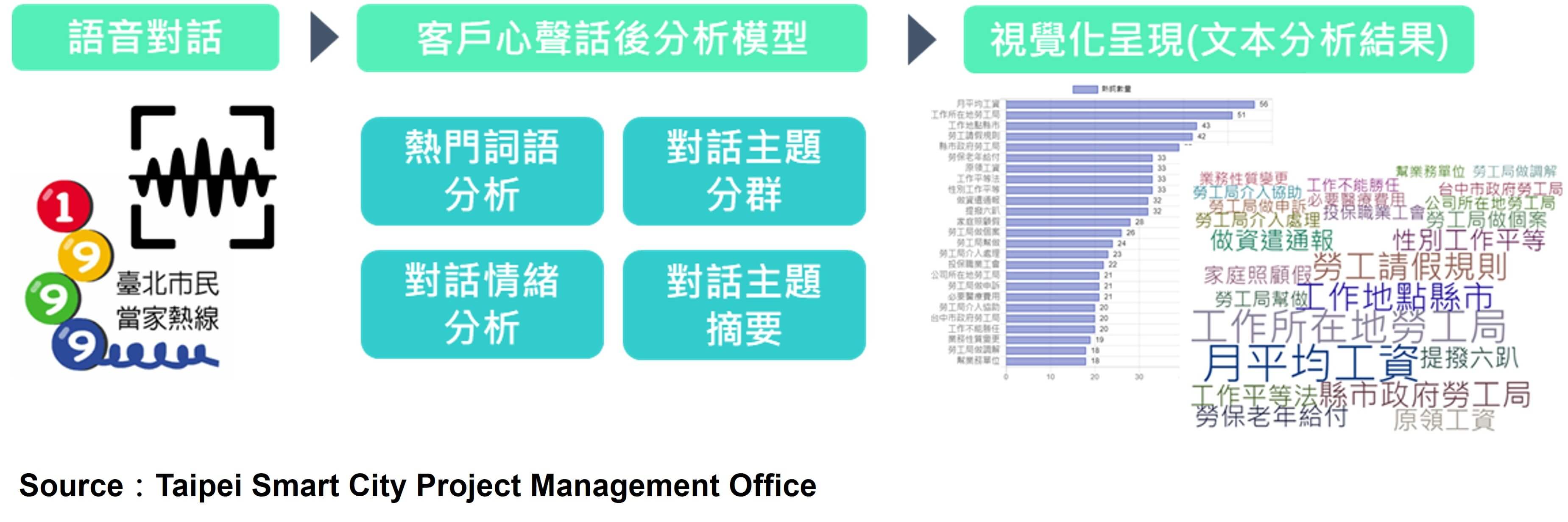
To address this challenge, Department of Information Technology of Taipei City Government implemented AI voice-to-text and text analysis technology, overhauling the 1999 service process. Firstly, the system instantly converts incoming calls into text. Once personal data has been de-identified, AI is employed for deep text analysis. The system automatically extracts summaries, flags keywords, and classifies issues, as well as visualizes popular topic trends using charts, including word clouds and trend graphs. Management can immediately grasp key citizen concerns regarding major municipal issues. Agents can bypass time-consuming transcription, performing only final proofreading and editing to quickly record cases, thereby significantly improving processing efficiency.
This initiative considerably reduces recording time and enhances the precision of textual records, thereby preventing information errors that may arise during personnel handover or multi-line operations. At the same time, the transcribed text records are linked directly to the City Government's FAQ knowledge repository and backend systems. This allows for faster resolution of issues during case processing, thereby reducing citizen waiting times.
Since the Taipei City Government unveiled the AI voice-to-text application at the Smart City Summit & Expo, the 1999 Hotline has seen a significant improvement in response speed and the precision of handling public feedback. This success has led to enhancements in service quality and citizen satisfaction. This application is not only a call process optimization, but also signifies a major progress in administrative governance. Implementing AI enables the 1999 Hotline to efficiently manage substantial public demand, decreasing the human burden and improving the speed and accuracy of responses. In conclusion, this intelligent upgrade solidifies the 1999 Hotline's strategic role as the heart of the City Government's "data-driven governance," serving as a critical platform for gaining public insight in real time and optimizing policy implementation.
With the rapid advancement of emerging technologies, Taipei City is proactively harnessing the power of AI to promote smart transformation. Using applications such as AI instant translation, intelligent navigation, and voice-to-text, the City is empowering municipal services across healthcare, tourism, and leisure, leading to tangible improvements in citizens' lives. In these applications, language ceases to be a communication obstacle, exploration becomes more diverse and interesting, and public demands receive more prompt responses. These digital transformations represent a shift in governance thinking, evolving from conventional manual service delivery to an AI-powered model characterized by smart, high-efficiency municipal governance. Through technological progress, citizens can look forward to more convenient, diverse, and precise services. Taipei City will continue to expand emerging public service applications, exploring further AI possibilities, and serving as the benchmark for smart city development nationwide.